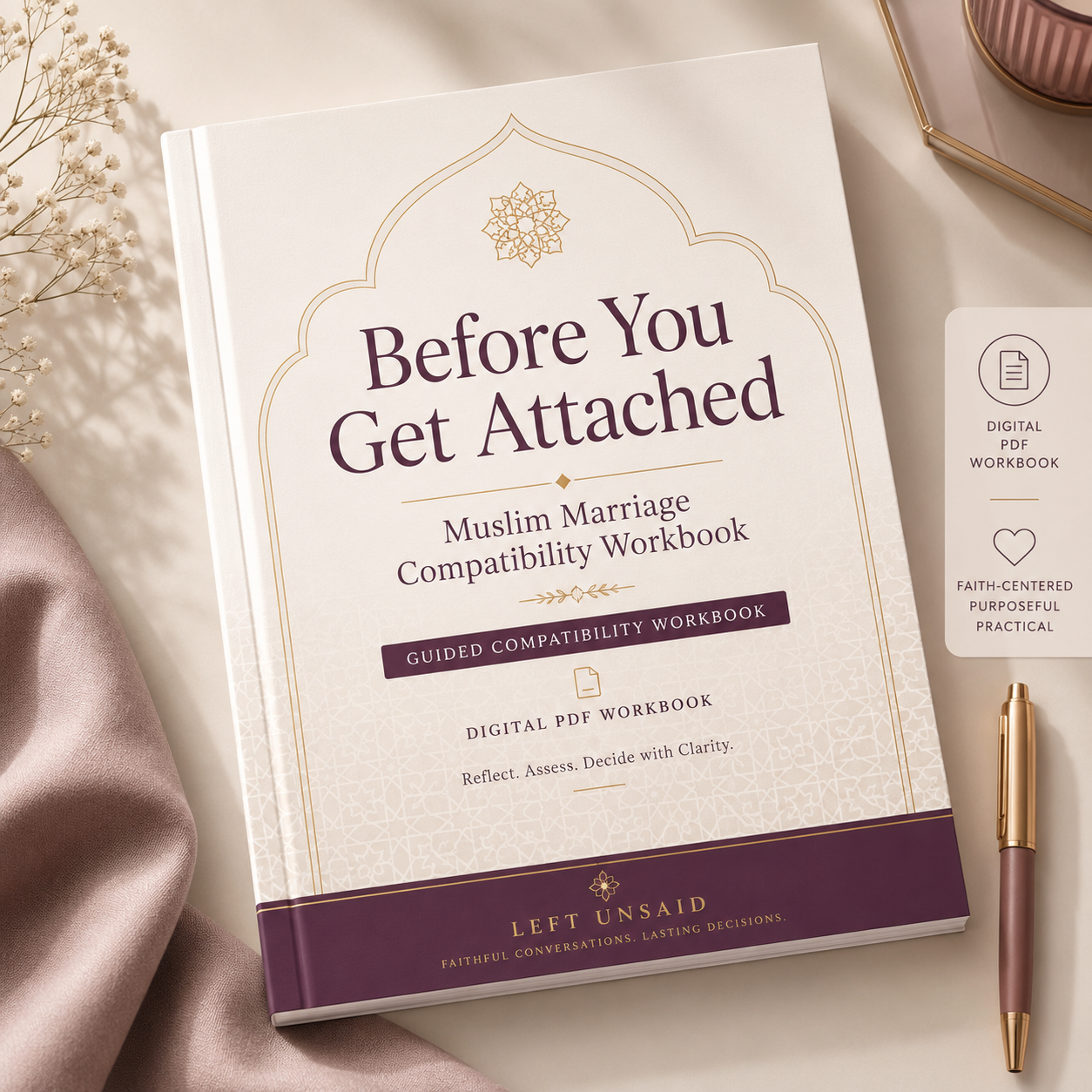
Before You Get Attached: Muslim Marriage Compatibility Workbook
Before You Get Attached: Muslim Marriage Compatibility Workbook
Couldn't load pickup availability
Muslim marriage readiness workbook
Ask the Important Questions Before Attachment Makes Them Harder to Ask
Before You Get Attached is a private, faith-aware workbook designed to help you explore marriage compatibility, notice emotional patterns, and have the conversations that are often postponed until feelings or pressure become stronger.
You may know that marriage requires more than chemistry.
But once hope, attention, family expectations, or emotional attachment enter the picture, it can become difficult to ask direct questions or take concerning answers seriously.
You may find yourself focusing on potential rather than patterns. You may avoid difficult subjects because you do not want to appear demanding, suspicious, or overly serious. You may assume important differences will somehow resolve themselves later.
This workbook helps you slow the process down enough to see what is actually in front of you.
Compatibility is not only about whether you like each other. It is about whether your values, expectations, behaviour, and vision of married life can realistically exist together.
What This Workbook Helps You Explore
Marriage intentions
Clarify seriousness, timelines, readiness, and whether both people are genuinely moving toward the same outcome.
Faith and religious practice
Discuss religious values, daily practice, expectations, differences, and how faith may shape married life.
Emotional compatibility
Explore communication, reassurance, affection, emotional availability, conflict, and the ability to repair after hurt.
Family involvement
Examine parental influence, in-law expectations, privacy, cultural traditions, loyalty, and marital boundaries.
Money and lifestyle
Discuss income, debt, spending, work, housing, financial expectations, and the lifestyle each person imagines.
Roles and responsibilities
Clarify household work, decision-making, independence, careers, caregiving, and unspoken expectations.
Children and parenting
Explore whether to have children, parenting approaches, education, discipline, family influence, and long-term values.
Boundaries and warning signs
Notice pressure, secrecy, control, inconsistency, manipulation, rushing, religious guilt, and fear-based behaviour.
More Than a List of Questions
A polished answer can sound reassuring. What matters is whether the answer matches the person’s behaviour, emotional maturity, and decisions over time.
That is why the workbook does not simply tell you what to ask. It helps you consider what different responses may reveal and what you may be tempted to overlook.
Question
How involved do you expect our families to be in decisions after marriage?
Listen for
Whether the person can value family closeness while also recognising that a marriage needs privacy, mutual decision-making, and boundaries of its own.
Pause when
They dismiss your concerns, expect their family to have automatic authority, or believe boundaries should apply only to your side.
Private reflection
Am I agreeing to something that already makes me feel powerless because I am frightened of losing this opportunity?
Inside the Workbook
- Private marriage-readiness self-assessment
- More than 100 guided compatibility and conversation prompts
- Faith and religious-practice reflection pages
- Marriage intentions and timeline worksheet
- Emotional compatibility and communication review
- Family involvement and boundary exercises
- Money, work, housing and lifestyle discussions
- Roles and household-expectation prompts
- Children and parenting compatibility questions
- Conflict, anger, accountability and repair review
- Red-flag and pressure-pattern guidance
- Facts versus hopes exercise
- Continue, Slow Down or Step Away framework
- First Five Conversations bonus guide
- Muslim marriage app safety and profile checklist
Who It Is For
This may help when you are:
- getting to know someone for marriage;
- using a Muslim marriage app;
- considering an introduction through family or community;
- already emotionally attached and trying to think clearly;
- unsure whether important differences can be resolved;
- preparing for serious premarital conversations;
- afraid of asking questions that might change the relationship.
This is not:
- a fatwa or Islamic legal ruling;
- a test that decides whether someone is your destined spouse;
- a replacement for an imam, scholar, counsellor or therapist;
- a guarantee that a marriage will succeed;
- permission to ignore threats, coercion, violence or abuse.
A faith-aware workbook, not a religious ruling.
This resource is designed to support reflection, emotional clarity, and practical conversations. Religious questions requiring a formal ruling should be discussed with an appropriately qualified and trusted Islamic scholar.
Safety should never be sacrificed to preserve appearances, avoid community judgement, or prove patience.
Private digital workbook
Clarity Is Easier Before the Questions Become Emotionally Expensive
Work through the workbook privately, use the prompts in serious conversations, and return to your answers as the relationship develops.
48-page PDF · Instant digital delivery · Download and keep permanently
Frequently Asked Questions
Is this workbook only for engaged couples?
No. It is designed for anyone seriously evaluating a potential Muslim spouse, whether you met through family, friends, community, social media, or a marriage app.
Can we complete the workbook together?
Yes, but it is best to complete the private reflection sections independently first. That makes it easier to recognise your genuine expectations before adapting your answers to please the other person.
Does the workbook provide Islamic rulings?
No. It is a faith-aware relationship and compatibility resource, not a fatwa service. Matters requiring a formal Islamic ruling should be taken to a qualified scholar.
Is this suitable for divorced Muslims?
Yes. The questions are relevant to first marriages, remarriage, divorcees, widowed Muslims, converts, and people entering marriage with children or previous relationship experience.
How will I receive the workbook?
After purchase, you will receive access to download the PDF digitally. No physical item will be shipped.
Can I print it?
Yes. The workbook can be read digitally or printed for personal use.
Can I share the PDF with someone else?
Your purchase is licensed for your personal use. The person you are considering for marriage may discuss the prompts with you, but the full file should not be redistributed or uploaded elsewhere.
Will this tell me whether I should marry someone?
No workbook can make that decision for you. It is designed to reveal areas requiring discussion, reflection, advice, or a slower pace so that your decision is based on more than hope or attachment alone.